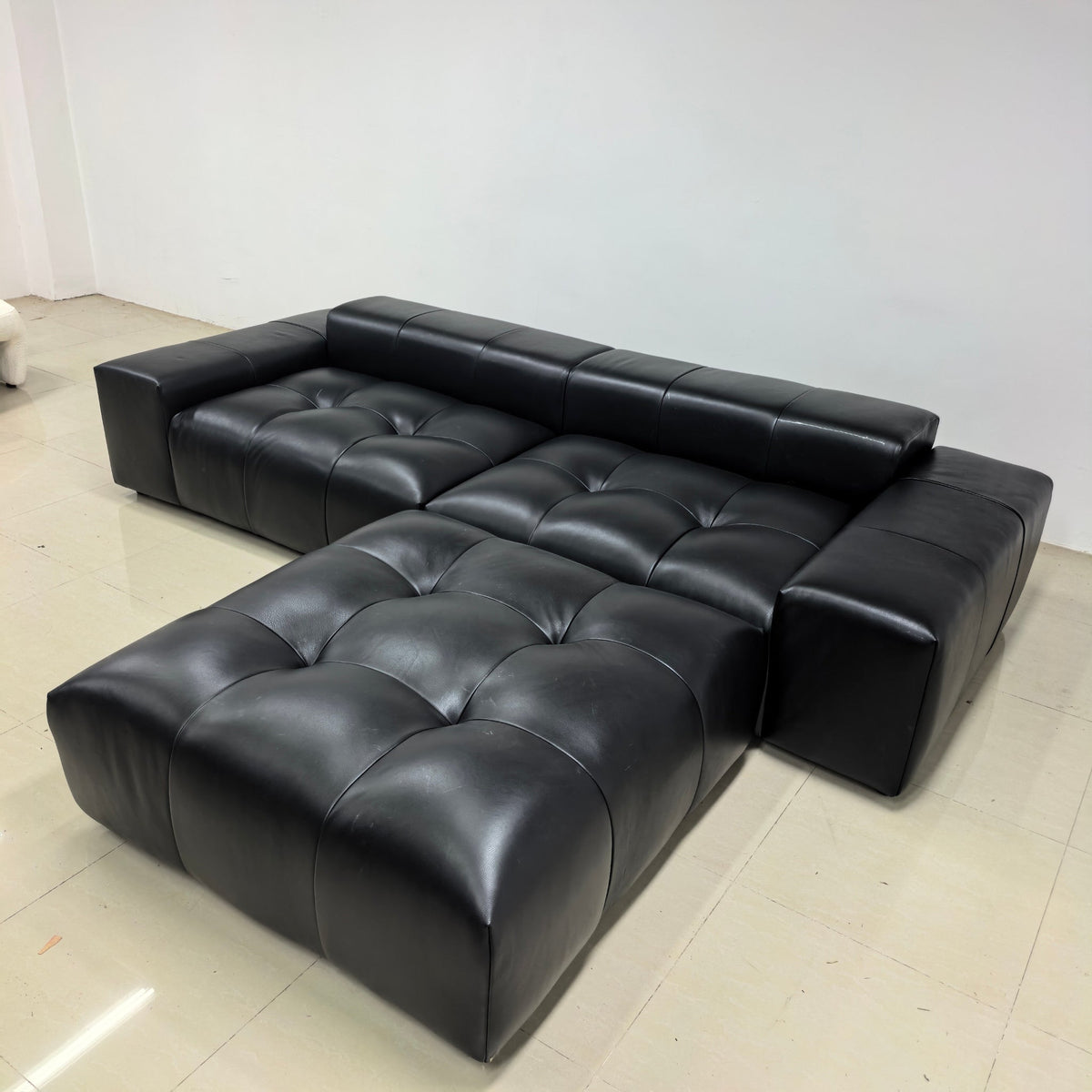

A cream sofa looks easy to choose on a phone. Zoom in and the surface starts to matter: one fabric has little raised loops; another has a fuzzy pile with a much finer texture. Both look soft. Which would you want under your arm every evening?
Bouclé and chenille can both work beautifully on upholstered furniture. The useful comparison starts with the actual sample, its fibre content and its care instructions. The fabric name alone leaves quite a lot unanswered.
First look at the yarn
Bouclé gets its distinctive texture from looped yarn. In a close-up, the surface can look pebbly, curly or loosely knotted. The size and spacing of those loops change the effect: a fine bouclé can be quite restrained, while a chunky version makes even a plain chair look textured.

Chenille yarn has a soft pile. It often gives upholstery a fuzzy surface, sometimes with a visible woven pattern underneath. The way that pile catches light can change the appearance as you move around it. Kvadrat’s Maple chenille specification is one documented example of that relationship between yarn, pile and light.
Neither name identifies one fixed fibre recipe. Before choosing, ask what the specific fabric is made from. A photograph and a label such as “bouclé” or “chenille” cannot tell you the percentages of wool, cotton, viscose or synthetic fibres.

A quick comparison
| What to compare | Bouclé | Chenille |
|---|---|---|
| Visible texture | Look at the size and openness of the loops. | Look at the pile and the weave beneath it. |
| Touch | Check whether raised loops feel comfortable against bare skin. | Check the feel of the pile in both directions. |
| Room effect | A pronounced surface can add interest to a simple shape. | Pile and light can give a colour a softer or more varied appearance. |
| Care | Follow the instructions for the exact fabric. | Follow the instructions for the exact fabric. |
Bring the sample into the room
Do not leave both samples flat on a desk and make the decision there. Hold each one upright where the sofa back will sit, then lay it horizontally where the seat will be. Check them near the window and again with your evening lamps on.
Put your rug sample or a cushion beside them. A pale fabric that looks comfortably warm on its own may look yellow next to a cool white wall. You do not need perfect colour theory to spot this; you need the materials next to each other.
For a curved sofa, drape the sample over a rounded edge. For a heavily seamed design, ask to see the fabric on similar upholstery. A small flat swatch is good for colour and touch, but it will not show every effect of padding, tension and seams.
Think about your particular household
Start with what actually happens on your sofa. Perhaps a dog sleeps on the same cushion each afternoon. Perhaps the room is mostly used for reading, or a toddler regularly arrives with sticky hands. Each situation points to a different question.
- For claws and sharp objects, inspect raised loops and loose yarns, and ask about snag resistance. A soft-looking surface is not proof that it will tolerate scratching.
- For frequent spills, ask for the exact approved cleaning method and any documented stain treatment. Neither bouclé nor chenille is automatically stain-resistant.
- For a sunny position, ask about lightfastness and consider how you will limit direct exposure.
- For bare arms and legs, keep the sample against your skin for a little while. A texture you enjoy touching briefly may feel different over a whole evening.
Avoid choosing a winner for every household. Compare the two fabrics you are actually considering, including their construction and care requirements.
A rub count does not predict years of use
Abrasion results can be useful, but they are only part of a fabric specification. The Association for Contract Textiles cautions that higher results do not necessarily mean a longer service life. Twice the abrasion cycles does not mean twice the years on your sofa.
Ask which test was used, then also look for information about pilling, colourfastness and care. If test data is unavailable, keep that uncertainty in the decision. A confident sales phrase is not a substitute for a result tied to the fabric you are ordering.
Read the cleaning instructions before the first spill
Some upholstery uses letter codes. In Ashley’s cleaning-code guide, W indicates water-based upholstery cleaning, S indicates solvent cleaning, and WS or SW allows the specified water-based or solvent method. X means vacuuming or light brushing, without water-based or solvent cleaners.
These letters are a starting point. Follow the instructions supplied for your own fabric and furniture, including restrictions on soaking or removing covers. A W label does not mean you can put the cover in a washing machine.
If the instructions are missing, get them before experimenting. Use an appropriate upholstery attachment to remove loose dust, and test any approved cleaning product in an inconspicuous area first. Kvadrat’s upholstery-care guidance also stresses checking the fabric and spot-testing before cleaning.
Three common questions
Is bouclé always made from wool?
No. The looped texture does not establish the fibre content. Check the composition of the exact fabric and colour you have selected.
Is chenille always easier to clean?
No. Its name does not tell you which liquids or cleaning products are suitable. Compare the actual care instructions before deciding.
Can I choose from an online photograph?
Use photographs to narrow the selection. For the final choice, a physical sample is more useful for colour, touch and texture. Ask about sample availability and make sure the sample reference matches the upholstery on your order.
Choose the surface you want to live with
If you love a visibly looped, textured finish, start with bouclé. If you are drawn to a finer fuzzy surface, include chenille in your shortlist. Then let the samples, care requirements and your room make the final decision.
Explore Classic Boucle and Chenille Helios, or ask Vintara Design about current samples and suitability for your chosen furniture. Confirm fibre composition, colour and care requirements before ordering.